How to Add a Unit in the SMS
 Overview
In your Student Management System, Programs are comprised of units or subjects, which can be added either automatically using the sync feature or manually.
When setting up your Programs, it is important to follow the correct sequence depending on your method:
- Syncing Units: Start by creating your Program first, then sync the Units.
- Adding Units manually: Start by creating your Units first, then build your Program.
Following these steps ensures a smooth and seamless process when setting up your Programs and Program Instances.
In this tutorial, we will show you how to add Units/Subjects using both the sync feature and the manual method.
 Step Tutorial
Adding Units Automatically Using the Sync Feature
When creating Nationally Accredited Programs, users have the option to use the Sync with TGA feature which will automatically add program details and related Units into the SMS as they are listed in training.gov.au.
There are two ways to add Units using this sync function:
- Sync with TGA (All Programs) - this button will sync all the Nationally Recognised Programs in the SMS with training.gov.au. This will add the program details and all the units of each program to the SMS.
- Sync Individual Programs - with this sync button, only the details and the Units for the selected program will be synced to the SMS.
When the Sync with TGA function is used, related Units for the program/s will be added in the SMS along with the following information:
- Unit Code - the Unit code will display as it is listed in training.gov.au
- Unit Name - the Unit name for the corresponding Unit Code will display as it is listed in training.gov.au
The following fields will have to be manually edited or completed:
- VET Flag - select No if the Unit is not for VET use or for Non-accredited programs. Select Yes if Unit is used for Vocational Education and Training purposes.
- Nominal Hours - enter the nominal hours for the Unit. This refers to the expected number of hours required to achieve the outcomes for the Unit of Competency. For Units of Competencies that are nationally recognised, Nominal hours can be found in the Agreed Nominal Hours page of NCVER.
- Subject Identifier - Local (WA) - this field is only required for training delivered in WA.
- Subject Field of Education Id - Select the Field of Education identifier for the Unit/Subject.

Important Note: To use the Sync with TGA button, ensure that the program names and program codes in the SMS is an exact match to the program name and code as it is listed in training.gov.au. Adding Units using the Sync with TGA button can only be done for Programs that are available in training.gov.au.
Adding Units Manually
Users have the option to manually add Units, particularly when creating Units for Non-accredited programs.
- In the side menu, go to Programs > Units. Click Add.
- Complete the fields below:
- Unit Code - enter a Unit or Subject code for easier identification of the subject.
- Active - toggle to specify if Unit is active and available for use. This defaults to Active.
- Unit Name - enter the name for the Unit or the Subject. This should be a descriptive name that will allow users to easily identify the Unit.
- VET Flag - select No if the Unit is not for VET use or for Non-accredited programs. Select Yes if Unit is used for Vocational Education and Training purposes.
- Nominal Hours - enter the nominal hours for the Unit. This refers to the expected number of hours required to achieve the outcomes for the Unit of Competency. For Units of Competencies that are nationally recognised, Nominal hours can be found in the Agreed Nominal Hours page of NCVER.
- Subject Identifier - Local (WA) - this field is only required for training delivered in Western Australia (WA)
- Subject Field of Education Id - Select the Field of Education identifier for the Unit/Subject.
- Once required fields are complete, click Save to add the Unit.
 Important Note: When adding Units for Nationally Recognised Training, make sure that the Unit name and Code is an exact match to the name and code listed in training.gov.au to prevent errors when submitting State or National reports. Ensure there are no extra spaces, symbols, unnecessary quotation marks or apostrophes in the Unit Name or Unit Code.
If the program is non-accredited, it is recommended to create or add your Units/Subjects first to streamline the program creation. If the programs are Nationally Recognised, programs can be created first and then synced with training.gov.au, allowing the related Units to be automatically added reducing time and effort required in creating Units. However, users always have the option to add Units manually even for Nationally Recognised Training.
How to Set Up Risk Ratings & Sample Sizes
Before scheduling validation events, ensure your Units and Programs have configured risk profiles. Risk ratings drive automated prioritization and sample size calculations across the system.
Unit-Level Configuration
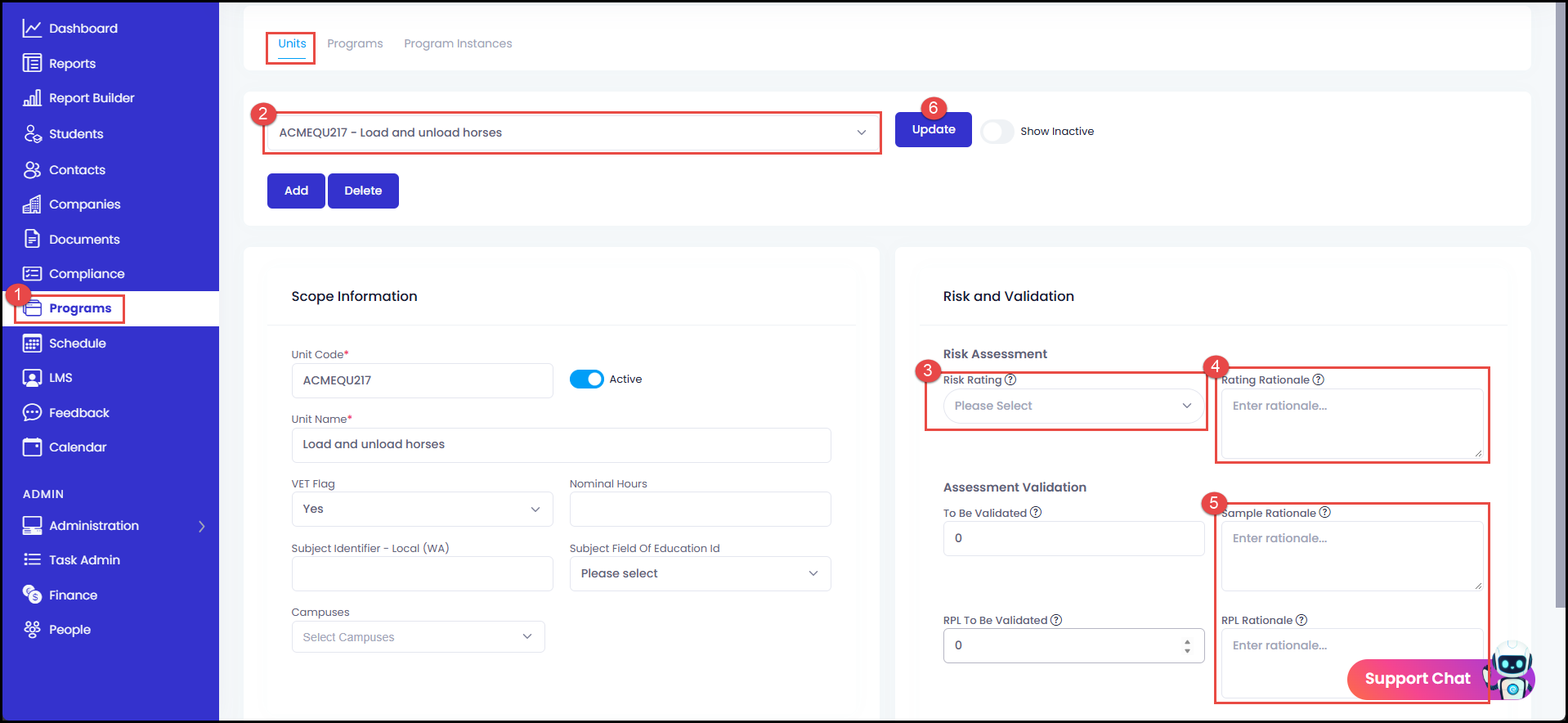
1. Go to the Units tab in the SMS. (Programs > Units tab)
2. Select a unit and look for the Risk and Validation section.
3. Assign a Risk Rating (1 to 5):
- 5 – Critical: Identified invalid assessments, serious safety/legal/licensing/regulatory risk, or systemic failure evidence. Requires frequent, in-depth validation.
- 4 – High: High-consequence outcomes, new/changed tools, new delivery modes, inexperienced assessors, or regulator priority areas.
- 3 – Medium: Moderate complexity and consequence, stable tools, experienced assessors, and compliant validation history.
- 2 – Low: Low safety/regulatory impact, stable tools, low complaints, and consistent past compliance.
- 1 – Minimal: Very low-impact, simple assessment design, minimal cohorts, and negligible consequence of incorrect judgements.
4. Enter the required Risk Rationale justifying the rating (e.g., licensing requirements, cohort complexity, assessor changes).
5. Specify the Sample Size ("To Be Validated ") and Sample Rationale for:
- Completed Assessments
- Recognition of Prior Learning (RPL)

TIP: Use the built-in tooltip guidance to align with statistical benchmarks (such as ASQA calculator benchmarks) and adjust upward for risk factors like multiple assessors or diverse cohorts.
6. Click on Update to save your changes.
Congratulations on completing this tutorial. We hope this has been helpful to you and your organisation. For any questions or concerns regarding this function, please reach out to the contact support via email.